
Last reviewed: December 8, 2025
An MSP can love your network and still pause at the first invoice. If billing looks unpredictable, sales stall. When it’s clean, automated, and integrated, MSPs sell voice, UCaaS, and connectivity without hesitation.
TL;DR MSP-led distribution now drives most IT and telecom spend, so your wholesale growth depends on how easy it is for MSPs to bill your services. Research shows roughly 70% of IT spending flows through channel partners, and cloud communications markets continue to expand, pulling voice and UCaaS into the MSP stack. The lever isn’t another feature; it’s predictable billing that fits PSA and accounting workflows. To grow through MSPs, remove billing friction and standardize on an MSP-ready billing hub.
Billing isn’t a back-office function
Billing is part of the product. For MSPs, an invoice is the moment of truth where quotes, usage, dates, taxes, and service names must reconcile. If they don’t, disputes start, tickets rise, and cash slows.
Why this matters now: channel partners already influence the majority of buying. Canalys forecasts that partner-delivered IT will account for about 70% of global spend in 2025. That means telecom wholesale growth is constrained or accelerated by what partners can confidently bill each month, not by what you can technically deliver. See Canalys’ latest updates: Navigating IT spending shifts and IT spending to expand 8% in 2025.
Cloud communications demand is rising alongside this channel shift. Multiple analysts project continued UCaaS growth through 2030 and beyond, reinforcing the need for MSP-ready billing of voice, UCaaS, and connectivity. Examples: Fortune Business Insights UCaaS forecast and Research and Markets UCaaS outlook.
Billing sets the front-end experience that decides MSP adoption
Our POV: MSPs don’t avoid telecom because of deployment. They avoid it when invoices create surprises. The commercial risk sits with the MSP, so they only scale services they can bill with confidence.
Direct sales tactics won’t fix this. What does: align billing with MSP workflows. Use consistent catalogs and bundles, predictable pricing rules, clear presentment, and outputs that slot into PSA and accounting without manual rework.
Trade-offs are real. The more flexibility in custom pricing and exceptions you allow, the higher the operational variance and dispute risk. Standardize what you can, and only allow exceptions with clear guardrails.
What billing actually dictates for MSP-led telecom
Billing determines more than revenue timing. It controls channel behavior:
- How quickly MSPs can start selling: clean SKUs, dates, and taxes shorten onboarding and first invoice time.
- How confidently they price and package: predictable rating and margins reduce bespoke quotes and discounting.
- How much support they need from the telco: fewer invoice tickets, fewer make-goods, fewer credit memos.
- Whether they trust the numbers: audit-friendly detail that matches quotes, CDRs, and service names in PSA.
- Whether telecom becomes a managed offering: stable outputs enable bundling voice/UCaaS with MSA renewals.
- Whether they risk their customer trust: clear, accurate, reconcilable invoices prevent churn-driving disputes.
Assumption: mid-market MSPs using a PSA and a cloud accounting platform.
How telecom wholesalers remove billing friction
Focus on six capabilities that map to MSP economics and operations:
- Billing clarity and accuracy. Align product names, service dates, and charges to quotes. Present usage detail customers can reconcile without turning the MSP into a tax advisor.
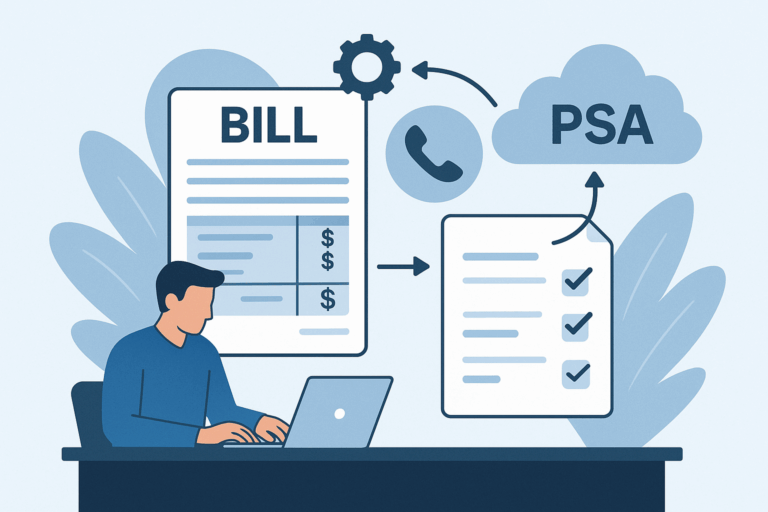
- Workflow alignment with PSA and accounting. Generate outputs the MSP can post and recognize without spreadsheets or portal hops. No field mapping guidance here, but the rule is simple: fewer manual steps, fewer errors.
- Partner margin preservation. Separate partner buy rates and end-customer sell rates with predictable bundle logic. Reduce one-off credits that erode margin.
- Consistent catalog and bundles. Offer repeatable bundles for UCaaS, voice, and connectivity with add-ons that price and present the same way every month.
- Multi-tenant management. MSPs need to manage many end customers from one place. Make tenant, site, and number-level views consistent across billing outputs.
- Operational scalability. Design for hundreds of small accounts, not one giant one. That’s the MSP world.
Brand bridge: How Datagate helps. Outcome: MSPs sell more telecom because billing becomes predictable and integrated. How: Datagate acts as the telecom billing hub that converts carrier usage into MSP-ready, PSA/accounting-friendly invoices for voice, UCaaS, and connectivity. Explore a real-world example: Datagate case studies.
Two commercialization paths for telcos: resell vs. white label
If you want to move fast, resell an MSP-ready billing hub alongside your wholesale offers. Package it as an option on every partner agreement. Outcome: immediate reduction in billing friction, earlier revenue, and fewer disputes.
If you want to own the experience, white label the billing hub. Add light professional services to guide partners through catalog setup and initial invoices. Outcome: consistent partner experience and deeper differentiation. Trade-off: more enablement, but higher stickiness.
Either path is viable. What matters is that every MSP gets a billing workflow that works on day one.
Brand bridge: Move from intent to action. Outcome: enable your MSP channel to bill telecom cleanly from the first month. How: standardize on Datagate as the billing hub and offer it as resell or white-label. CTA: schedule a discussion at Datagate contact.
Objections and pitfalls to address early
“Our network quality sells itself.” Quality matters, but invoices decide renewals. If billing creates noise, MSPs throttle new orders to protect customer trust.
“We can fix invoices manually.” Manual fixes don’t scale across dozens of MSPs and hundreds of tenants. They also hide true support costs and inflate partner CAC.
“Partners will adapt to our portal.” MSPs adapt once. Then they standardize on vendors who respect their PSA and accounting workflow. If your outputs don’t fit, they’ll sell someone else’s UCaaS or connectivity.
“Taxes are the MSP’s problem.” Telecom taxes still appear on your partner’s invoice. If presentment is unclear, the MSP fields the dispute. Provide audit-friendly outputs without stepping into tax advice.
FAQ
Q: What’s the fastest way to de-risk first invoices for new MSP partners?
A: Ship standard bundles with pretested invoice outputs and a short checklist that confirms names, dates, and taxes line up with the PSA. Minimize custom pricing on month one.
Q: Do we need to change our OSS/BSS?
A: Not necessarily. Insert a billing hub that translates rating and usage into MSP-ready outputs. Keep OSS/BSS as-is and reduce integration risk.
Q: Where do disputes usually start?
A: Mismatched service names, mid-cycle activations without prorate clarity, and unclear surcharges. Fix with consistent catalogs, effective-dating, and audit-friendly detail.
The takeaway for telecom executives
MSP-led growth is won or lost at billing. Make invoices predictable, align with PSA and accounting, preserve partner margin, and standardize bundles. Do this, and MSPs will sell your telecom services at scale.
Implications / Next steps
- Assess: sample 50 invoices for naming, dating, and variance against quotes.
- Standardize: define 6–12 MSP-ready bundles for UCaaS, voice, and connectivity.
- Integrate: deploy a billing hub that exports PSA/accounting-ready outputs.
- Enable: choose resell or white-label, then add light partner onboarding.
- Measure: track dispute rate, DSO, partner ticket volume, and attach rate per MSP.
Sources
Canalys: Navigating IT spending shifts (June 9, 2025)
Canalys: IT spending to expand 8% in 2025; partner-delivered IT ~70% (Nov 27, 2024)
Fortune Business Insights: UCaaS market outlook to 2032 (Nov 7, 2024)
Research and Markets: UCaaS forecast to 2030 (Jan 30, 2025)