
Last reviewed: October 17, 2025
Picture a Friday close-of-business: provider CDRs arrive, billing queues are full, an account manager sees a spike in disputed calls, and AR is wondering why cash didn’t hit the bank. The path from raw usage to posted payment for MSPs is a chain of small handoffs—each one a chance to slow cash or create disputes.
TL;DR: This article walks through the end-to-end MSP telecom billing flow for US operations: how CDRs arrive, how usage is normalized and rated, how telecom taxes and surcharges are applied, how invoices sync to PSA and accounting systems, and how payments and AR reconciliation close the loop. Read it to map these steps to your stack, spot common failure points, and get a 1-page checklist you can use for a first-invoice review.
Why mapping the full flow matters now
MSPs are consolidating multiple voice, data, and UC providers onto single invoices for customers. That improves customer experience but raises operational complexity. When usage files are late, formats change, rating rules are wrong, or tax jurisdictioning is off, the result is billing rework, disputed invoices, and delayed cash.
One billing manager at a mid-market MSP told us that a single provider format change cost two staff days to troubleshoot—time that could have been used on onboarding new accounts. That’s common. Providers change CDR schemas. States change communications tax rules. PSA fields get out of sync with billing systems. If you haven’t mapped the full flow, you don’t have a fast fix.
What good looks like: automated CDR ingestion, predictable rating rules, automated telecom tax application, one-click export to PSA and accounting, and automated AR posting with payment reconciliation. That reduces dispute rates and speeds days-to-cash.
Our point of view: fix the handoffs, not just the tools
Our POV: the billing problem is mostly process and mapping, not raw tooling. You can buy rating engines and tax modules, but if your field mapping, enrichment rules, and export templates are brittle, you’ll still rekey and reconcile manually.
Trade-offs to accept up front: building one highly flexible ingestion pipeline costs more initially than a simple SFTP drop-and-run process, but it saves repeated firefighting for new providers and services. Conversely, buying a closed, single-provider solution can be faster to deploy but will cost you when you add providers or white-label invoices.
Be prescriptive: treat the end-to-end flow as a set of immutable handoffs. Define the input contract (CDR schema), the transformation contract (normalized usage record), the rating contract (rated line item with tax fields), and the export contract (PSA and accounting invoice format). When every change touches a single contract, your change window shrinks.
Framework: a simple swimlane for CDR-to-cash
Here’s a practical swimlane you can paste into an internal doc. Each step lists the key artifact and a measurable checkpoint.
- Provider → Ingestion: CDR files arrive (SFTP, API, or flat files). Checkpoint: file checksum and schema version.
- Ingestion → Normalization: parser maps provider fields to canonical fields (timestamp, caller, callee, duration, service type, digits). Checkpoint: record-level schema validation and sample row counts.
- Normalization → Rating: apply rating rules (per-minute rates, bundled/overage logic). Checkpoint: sample rated records and expected charge totals vs. sample bill from provider.
- Rating → Taxing: apply telecom taxes, state/local jurisdiction logic, and regulatory fees. Checkpoint: tax jurisdiction and tax code per line item validated.
- Rated Lines → Invoice Composition: consolidate by account and invoice template rules (single invoice vs. by site). Checkpoint: invoice preview matches expected layout and totals.
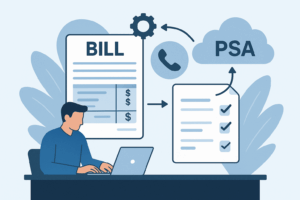
- Invoice → PSA/Accounting Export: push invoice and AR line items into PSA (ConnectWise/Autotask) and accounting (QuickBooks/Xero). Checkpoint: invoice posted and customer balance updated without manual rekeying.
- Accounting → Payments & AR: payments processed (Stripe/Authorize.net/IPPay), automatic deposit reconciliation, and exception handling for partial payments or chargebacks. Checkpoint: unapplied payments ≤ target percentage.
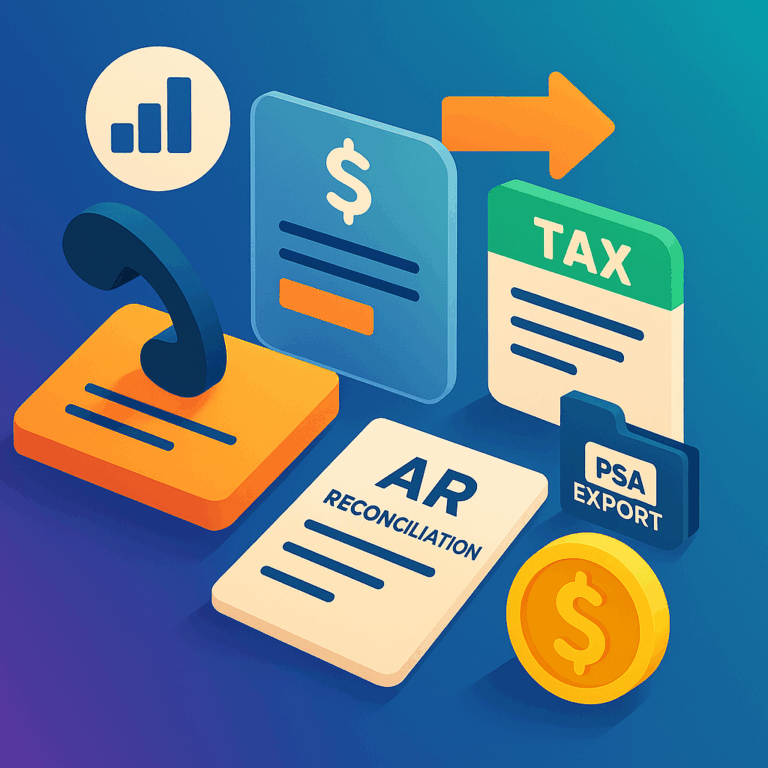
Diagram description: A left-to-right swimlane showing systems: Provider → Datagate-style rating/tax engine → PSA → Accounting → Payments/Bank. Key handoffs labeled: File schema, Normalized usage, Rated lines + tax codes, Invoice JSON/CSV, AR posting, Payment reconciliation.
Compact table — key fields to normalize
| Provider field | Canonical field | Why it matters |
| Call start (epoch) | start_timestamp | Synchronizes rating period and tax jurisdiction. |
| From number / DID | caller_id | Used for customer mapping and tax jurisdiction lookup. |
| To number | callee_number | Determine usage type (local, toll-free, international). |
| Billing units | duration_seconds | Feeds per-minute or per-second rating logic. |
Assumes a mid-market PSA stack and standard payment processors. Adjust for legacy PSAs or bespoke accounting rules.
Applications: what RevOps and Billing Managers actually do with this flow
If you’re a VP Revenue Operations or a Billing Manager, here are practical, role-aligned applications and steps you can run this quarter.
1) Quick gap map (one afternoon). Export last month’s provider CDR sample, a preview invoice, and the PSA invoice export. Map fields and note mismatches. Goal: find the 3 fields that cause most rework (usually customer identifier, tax jurisdiction, or service code).
2) First-invoice checklist. Before you send the first consolidated invoice to a customer: confirm provider file arrival, validate sample rated totals, validate tax application by state for the major line items, preview invoice in PSA, and run a manual payment-posting test. This cuts first-invoice disputes by >50% in teams that follow it.
3) Automate exceptions. Build rules that flag (a) provider line counts that differ >10% from expected, (b) tax rate deviations vs. previous month, and (c) invoices with large one-time non-recurring charges. Route these to a billing analyst queue rather than stopping an entire batch.
4) Reconciliation cadence. Close AR weekly for telecom invoices. Match payments to posted invoices within 72 hours and maintain a short exceptions loop for partial payments. Use automated webhooks from payment gateway to accounting so posting is automatic.
Integrations that matter: make sure your rating/tax engine supports connectors to ConnectWise and Autotask for PSA, and QuickBooks or Xero for accounting. If you’re evaluating solutions, see our integrations overview for typical connectors and templates: /integrations.
What good looks like
All CDRs normalized on arrival, rated overnight with taxes applied, invoices exported to PSA by 06:00, payments posted and reconciled within 3 business days. If you want a quick fit check, try our 12-minute checklist: Book a 15-minute first-invoice review.
Common objections and pitfalls (and how to handle them)
“Our providers don’t deliver consistent CDRs.” That’s common. Treat each provider as a variation and build parsers with versioning. Keep a quick test harness that compares a provider’s sample rated totals to an expected vendor bill; discrepancies are often off-by-one field shifts.
“Telecom taxes are a legal maze.” True. Telecom-related taxes and fees vary by state and locality. Use a communications-focused tax engine and maintain a regular update cadence with your provider. For background on communications taxes and jurisdiction complexity, see this overview: Avalara — Communications taxes explained.
“We can’t change our PSA mapping.” If the PSA can’t be modified, move flexibility into the export layer: create transformation templates that produce the exact CSV/JSON the PSA accepts. Our POV: adapt the middleware before changing core systems.
Common pitfall checklist
- No schema versioning for CDRs — add it.
- Tax codes embedded in provider fields — surface them to rated lines.
- Manual payment reconciliation — automate gateway webhooks.
How our company solves this
Datagate helps MSPs rate usage, calculate telecom taxes, and export clean invoices into PSA and accounting. We do this with deep PSA connectors, a telecom-grade tax engine, and templates to avoid rekeying. Book a 15-minute first-invoice review.
FAQ
Q: How do I know if a CDR file is trustworthy?
A: Verify checksum, row counts, sample totals, and schema version. Run a daily baseline check that compares this month versus last month for line counts and total minutes per account.
Q: Should I apply taxes at line item level or invoice level?
A: Apply taxes at line item level when possible. That preserves jurisdiction specificity and reduces downstream reconciliation when customers query particular service charges.
Q: What’s the fastest way to reduce billing disputes?
A: Implement a first-invoice preview workflow that validates rated totals and tax calculations and send a customer-friendly invoice preview before the first live billing.
Sources
Avalara — Communications taxes explained
Disclaimer: This article provides general information and examples, not legal or tax advice. Confirm tax rates and regulatory obligations with your advisors and the applicable authorities.
Success metrics: reduce invoice disputes by 30–60%, cut manual posting by 80%, and reduce days-to-cash by standardized exports and automated payment reconciliation. Want the 12-minute fit check?