
Last reviewed: November 10, 2025
Your MSP sells Teams Phone, SIP trunks, and mobile add-ons. Billing starts in ConnectWise, taxes live in a separate engine, QuickBooks is the financial record, and invoices travel through spreadsheets. The result: mismatched line items, tax sourcing mistakes, and invoices that take weeks to collect.
TL;DR — MSP telecom billing must be one connected flow. Datagate turns ConnectWise + QuickBooks from a series of handoffs into a single, auditable billing hub: ingest CDRs, rate correctly, apply telecom taxes, create one reconciled invoice, and post to QuickBooks without rekeying. Try a focused week‑one pilot to validate line‑by‑line accuracy and collections impact.
Why telecom billing still breaks at scale
Most MSPs treat telecom billing as a string of handoffs: carriers export CDRs, an operator cleans them in a spreadsheet, someone guesses tax sourcing, and totals are rekeyed into accounting. That approach works for a handful of customers but fails as CDR volume, bundled plans, and multi‑jurisdictional taxes grow. The result is disputes, audit risk, and slower cash collection.
Market context matters. UCaaS and Teams Phone adoption continue to climb — Microsoft reported meaningful growth in Teams Phone PSTN users in 2024, highlighting why MSPs are seeing more voice usage and more CDRs to rate and tax. Microsoft: Discover why over 20 million PSTN users trust Teams Phone.
Telecom taxes are a special case. Communications taxation is complex because rates and rules vary by local, state, and special taxing districts; sourcing is often ambiguous for VoIP and bundled services. For these reasons many MSPs rely on dedicated tax engines rather than manual rules. Avalara: Understand the complexity of communications tax.
Our POV: Treat telecom billing as a single hub that respects your PSA and GL
Our core belief: ConnectWise stays the PSA of record, QuickBooks stays the financial record, and a telecom billing hub owns rating, tax sourcing, and final invoice composition. That hub must map fields precisely to both systems so postings are deterministic and auditable.
Why this matters for MSP leaders: when line items, descriptions, and tax lines match what your customer expects and what your GL needs, disputes drop and collections speed up. In practice, the most common dispute driver is mismatched line descriptions and tax lines, not the invoice total. Standardize those at rating time and you remove the primary source of friction.
Our POV on trade‑offs: the hub adds configuration and a short onboarding cycle, but it removes recurring manual effort and month‑end reconciliation labor. For very small portfolios (fewer than ~10 voice accounts with low CDR volume), the hub may be overkill; but for channel MSPs, UCaaS sellers, and reseller programs, the ROI from reduced disputes and faster DSO is clear.
ConnectWise + QuickBooks: one flow, clear field mapping
ConnectWise Manage and QuickBooks Online are common pieces of an MSP stack. ConnectWise captures service agreements and ticket billing lines while QuickBooks holds GL accounts and receives the invoice posting. Many integrations sync invoices directly, but telecom billing needs rating and tax correctness before anything posts. ConnectWise marketplace listings and integration partners show there are multiple ways to sync data — a dedicated telecom hub sits between them and enforces telecom‑grade rules. ConnectWise Marketplace: QuickBooks integration and automation platforms illustrate typical patterns for PSA↔GL syncs. Zapier: ConnectWise + QuickBooks integrations.
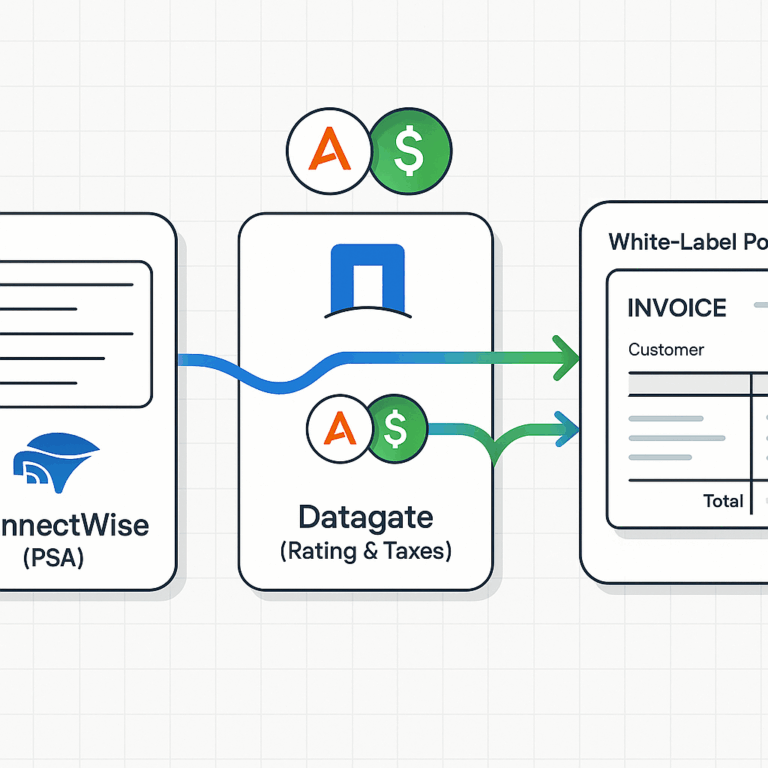
Here is a simple 3‑box flow to visualize the approach:
- ConnectWise (customer, contract, service items)
- Datagate (CDR ingestion & rating • tax sourcing • invoice composition)
- QuickBooks (single reconciled invoice • GL mapping) + Customer Portal (white‑label)
Compact field-mapping table (example)
| ConnectWise field | Datagate field | QuickBooks field |
| Company ID | Customer ID | Customer |
| Service Item ID | Rate Code | Product/Service Item / GL Account |
| Quantity (minutes, sessions) | Quantity | Qty |
| Line Description | Standardized Line Description | Line Memo |
| Invoice Status | Invoice Status Sync | Paid/Unpaid |
Assumes a mid‑market MSP stack using ConnectWise Manage and QuickBooks Online. Mapping these five fields proves the integration semantics for most telecom invoices.
How Datagate fits — the three pillars
Pillar 1 — Ecosystem-first integration. Datagate syncs customer identities, service items, and invoice metadata with ConnectWise while preparing a single reconciled invoice for QuickBooks. This keeps ConnectWise as the contractual system and QuickBooks as the financial system, removing manual translations and rekeying during month‑end.
Pillar 2 — Telecom‑grade rating and tax correctness. Datagate ingests CDRs from carriers or PBX, applies bundle rules and surcharges, and uses supported tax engines to source jurisdictional taxes at rating time. Datagate integrates with tax engines such as Avalara and other communications tax services so the tax lines you post align with authoritative sources. See Avalara guidance on why communications tax engines are critical for sourcing and rate accuracy. Avalara: communications tax complexity.
Pillar 3 — Cash and operational runbooks. Datagate delivers a white‑label portal, auto‑pay options (card, ACH, Stripe), and runbooks that tie invoices to AR workflows and reconciliation rules in QuickBooks. Customers that enable portal and auto‑pay reduce friction and shorten days‑sales‑outstanding.
Our POV: do rating and tax sourcing before anything posts. If you wait to apply tax rules inside QuickBooks or in a spreadsheet after rating, you will produce inconsistent tax lines and increase audit risk.
Practical applications — what billing managers and finance leads will notice
Immediate wins:
- One invoice per customer that consolidates multi‑provider services and usage-based charges.
- Line‑level descriptions that match what sales and support expect and what customers recognize, reducing disputes.
- Tax lines sourced by service and location at rating time, lowering audit risk.
Walkthrough vignette — the first invoice QA:
1) Export one week of CDRs and pick three recurring items to test. 2) Pull the matching ConnectWise service item IDs and QuickBooks GL accounts. 3) Configure those mappings in Datagate and run a test invoice. 4) Compare line‑by‑line: quantities, unit price, standardized description, and tax lines. That one test proves the semantic handoff and surfaces any mapping mismatches.
Quick technical note for systems engineers: Datagate supports SFTP and API CDR ingestion and provides field‑level transformation maps for CSV imports. A sandbox test with sample CDRs and a test QuickBooks company is the fastest way to validate end‑to‑end posting.
Outcome: one reconciled invoice that posts cleanly to QuickBooks and keeps ConnectWise as the PSA of record. How we do it: telecom rating, tax sourcing, GL mapping, and a white‑label portal. CTA: Book a tailored walkthrough to map your ConnectWise + QuickBooks handoffs.
Implementation checklist: run a 5‑day pilot
Day 0: Roles & access. Owner: Finance lead. Operator: PSA admin. Engineer: Datagate onboarding specialist.
Day 1: Data inputs. Export sample CDRs (one week). Export ConnectWise customer and service item CSV. Provide QuickBooks test company access.
Day 2–3: Mapping & config. Map five core fields (Customer ID, Service Item/Rate Code, Quantity, Unit Price, Tax Code). Configure the tax engine connection and jurisdiction sourcing.
Day 4: Test invoice. Generate a test invoice in Datagate and perform a line‑by‑line comparison to manual expectations.
Day 5: Portal & payment. Enable the white‑label portal and one payment method; verify payment and reconciliation posts to QuickBooks.
Acceptance criteria: invoice totals match manual calculation within cents; tax lines match the tax engine output for test invoices; test payment reconciles automatically in QuickBooks.
Objections and how to answer them
“Won’t this double‑post invoices between ConnectWise and QuickBooks?” — Datagate posts one reconciled invoice to QuickBooks and updates invoice status back to the PSA. Field mappings are explicit so duplication is avoided.
“How do we know the tax engine is correct for every state or district?” — Datagate integrates with communications tax engines that specialize in local jurisdiction sourcing and filing. These engines track thousands of local tax jurisdictions and are the authoritative source for communications taxes; you still run a first‑invoice QA during onboarding to catch setup edge cases. Avalara: Returns for Communications.
“Is onboarding disruptive?” — A focused week‑one pilot with clear roles proves the flow. Most MSPs realize the onboarding time is offset by reduced month‑end reconciliation and faster AR within a few cycles.
Outcome: reduced disputes and faster collections. How: Datagate maps ConnectWise service items to Datagate rate codes, applies telecom tax engines at rating time, and posts a validated invoice to QuickBooks. CTA: View the one‑invoice demo or book a tailored walkthrough.
FAQ
Q: How does Datagate prevent duplicate invoices between ConnectWise and QuickBooks?
A: Datagate composes a single reconciled invoice and posts it to QuickBooks. It then sends an invoice status and reference back to ConnectWise so both systems show the same state. That two‑way status sync avoids double‑posting.
Q: Which tax engines does Datagate support for US telecom taxes?
A: Datagate integrates with leading communications tax engines and supports setups that use Avalara and comparable specialist providers; we enforce sourcing rules at rating time and run first‑invoice QA. See communications tax guidance from Avalara for more detail. Avalara: communications tax complexity.
Q: What are the minimum data items we need to run a test invoice?
A: A sample of CDRs (one week), ConnectWise customer IDs and service item IDs, and test QuickBooks credentials (sandbox) are enough to run a meaningful test invoice.
Sources
- Microsoft: Discover why over 20 million PSTN users trust Teams Phone.
- Avalara: Understand the complexity of communications tax.
- Avalara: Returns for Communications.
- ConnectWise Marketplace: QuickBooks integration.
- Zapier: ConnectWise + QuickBooks integrations.
Meta description: MSP telecom billing in one stack: how Datagate centralizes CDR rating, telecom taxes, ConnectWise mapping, and QuickBooks posting to speed cash.
Suggested URL slug: msp-telecom-billing-datagate-connectwise-quickbooks