
Last reviewed: December 8, 2025
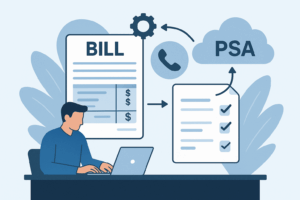
Your best MSP partner tells you they paused quoting voice because last month’s invoices didn’t match their PSA. Their CFO flagged unexplained usage lines and taxes. The deal slipped, and a competing carrier won on a cleaner bill, not a better network.
TL;DR: Telecom growth in SMB and midmarket rides on MSP-led distribution. The biggest blocker is billing friction: unpredictable usage rating, complex taxes, and weak PSA/accounting alignment. Telecom wholesalers that remove this friction become easier to sell, easier to support, and harder to replace. The move: standardize an MSP-ready billing experience and use a dedicated billing hub to make it predictable at scale.
Telecom is essential, but often a hard add for MSPs
MSPs now mediate most business technology purchases, and telecom follows that trusted relationship. Canalys projects partner-delivered IT will account for about 70% of total IT spending in 2025. That makes MSPs the downstream channel telecom wholesalers must enable. Canalys: IT spending 2025, 70% via partners.
At the same time, UCaaS keeps expanding as organizations consolidate voice, video, and messaging into cloud platforms. Recent forecasts put UCaaS at roughly 262 billion dollars by 2030, with high-teens growth through the decade. This demand is real, and it is moving through MSPs. Grand View Research: UCaaS to 2030.
So why do many MSPs hesitate to lead with telecom even when customers ask for it? Because billing complexity turns a straightforward sale into operational risk.
Why MSPs stall on telecom: six frictions to remove
Telecom only becomes a priority for MSPs when the operational friction is removed. The fastest path is fixing the billing experience.
- Billing complexity: Rating usage correctly and aligning charges to quoted bundles and dates is hard. Errors surface on customer finance calls, not in the lab.
- Tax exposure: In the United States, telecom invoices can involve federal fees, state and local taxes, and 911/988 surcharges. These change and compound. In 2025, wireless taxes and fees hit a new high, reflecting both federal and state components. Tax Foundation: 2025 wireless taxes.
- Usage variability: Seats look simple, but minutes, toll-free, e911, international, and add-ons create volatility. MSPs bear dispute risk if invoices drift from expectations.
- Time-consuming onboarding: Spreadsheets and manual rating slow the first 10 customers and block the next 100.
- PSA integration gaps: If invoices cannot land cleanly in PSA and accounting, month-end close breaks. MSPs need predictable mappings, not heroics.
- Low perceived margin: Partners discount future margin when billing looks risky. Clean billing raises confidence and deal velocity.
The market has shifted: design for the downstream MSP channel
Direct-only motions are losing efficiency. MSPs own the day-to-day relationship, bundle services, and handle support. Telecom wholesalers win when they align to MSP workflows and economics.
What that requires is not new products, but predictable operations. The priority list is consistent across successful channels:
Billing clarity and accuracy: One invoice that matches quotes, dates, and bundles the partner sold.
Workflow alignment: Outputs that map to the MSP’s PSA and accounting processes without manual transforms.
Margin preservation: Transparent rating and fees so partners can price with confidence and defend margin.
Consistent catalog and bundles: A clean, MSP-ready product list that travels from quote to invoice.
Multi-tenant management: Repeatable setup for many customer tenants, not one-off projects.
Operational scalability: Automation that makes the 50th partner and the 500th partner equally predictable.
A practical lens for telecom wholesalers: the Billing Alignment Framework
Use this five-step lens to stress-test your channel offer:
- Normalize: Convert CDRs and supplier files into a standard internal model before pricing rules apply.
- Package: Map usage and features to the MSP’s sellable bundles and price books with clear names.
- Rate: Apply rating tiers and discounts deterministically, with version control and audit logs.
- Tax & fees: Attach the correct taxes and surcharges per jurisdiction and service category, with readable line-item descriptions.
- Publish: Deliver MSP-branded invoices and summaries that post into PSA and accounting without manual edits.
When each step is explicit and automated, disputes drop, DSO improves, and partners add more seats. When any step is ad hoc, MSPs slow down or stop.
What to implement now: make billing predictable for MSPs
Start where friction hurts revenue the most. Focus on the first invoice the partner’s customer sees.
Standardize invoice outputs: Provide MSP-branded PDFs and data exports with consistent fields: service name, location or site, user or extension, period, usage detail, taxes, and surcharges. Match PSA agreement names and dates.
Provide an MSP-ready catalog: Offer a small set of bundles with clear inclusions: seats, domestic minutes, e911, toll-free, and common add-ons. Keep names stable for at least two quarters.
Adopt a dedicated billing hub: Use a telecom billing hub to translate supplier usage into MSP-packaged services and push clean outputs into PSA and accounting. This reduces operational risk and makes partner onboarding repeatable.
Offer two commercial paths: Resell the billing hub for fast go-to-market, or white-label it to embed billing as part of your wholesale offer. Both paths should keep implementation light for the MSP.
How Datagate helps (brand bridge)
Outcome: Faster MSP adoption, fewer disputes, and invoices that land cleanly in PSA and accounting.
How: Datagate operates as the billing hub MSPs rely on: it rates telecom usage, assembles MSP-branded invoices with readable taxes and fees, and integrates into MSP workflows. See an example in the SkySwitch case study.
CTA: Want to add an MSP-ready billing platform to your wholesale portfolio or white label it under your brand? Talk to Datagate.
Common objections and practical responses
“We already have a billing system.” Most carrier billing stacks were built for direct enterprise billing. MSPs need different outputs: partner-branded invoices, PSA alignment, and predictable usage mapping. Keep your existing stack for upstream rating and add an MSP-facing billing hub for channel scale.
“MSPs should handle taxes.” Partners will sell what they can bill confidently. Clear, automated tax and surcharge handling reduces their risk and your churn. The US tax environment is complex and changing, which argues for systematic handling, not spreadsheets. Tax Foundation: 2025 wireless taxes.
“We cannot expose that much usage detail.” Detail prevents disputes. Summaries are fine for executives, but finance teams need fields they can reconcile. Provide both: a one-page summary and a detailed breakdown.
“Margins will shrink.” Clean billing improves close rates, reduces credits, and lowers support costs. Channel productivity often outweighs nominal margin on any one line item when disputes disappear.
Final takeaway: remove billing friction to unlock MSP-led growth
The market already moved to partner-led distribution, and UCaaS demand continues to rise through MSPs. The constraint is not the network. It is billing friction. Give MSPs invoices that match what they sold, integrate with the systems they use, and withstand finance scrutiny. Do that, and your channel grows.
FAQ
Is this only about UCaaS? No. The same billing issues surface in SIP, connectivity, and bundled telecom services. Fixing billing helps across the portfolio.
Can we phase this in? Yes. Start with new partners or one region. Standardize outputs, then migrate existing partners on renewal.
White label or resell? Choose based on your brand strategy and services model. White label if you want full brand control. Resell if you want speed.
Sources
Canalys: IT spending to expand in 2025, partner-delivered IT ~70%
Grand View Research: UCaaS market to 2030, growth outlook
Tax Foundation: 2025 wireless taxes and fees complexity
Implications / Next steps
- Audit your first-invoice experience for two MSP partners this month.
- Decide whether to add an MSP-facing billing hub as resell or white label.
- Publish an MSP-ready catalog: 3 to 5 bundles with stable names for two quarters.
- Set invoice fields that finance teams need: site, user, period, usage, taxes, surcharges.
- Contact Datagate to map integrations and a 60-day pilot with selected partners: schedule a discussion.