
Last reviewed: October 6, 2025
Most organizations treat an LMS like a switch: flip training on, wait for completion reports, and assume behavior follows. The problem is obvious in the first week after launch when usage spikes and then flattens into the license graveyard. To change what people do every day, you need two things working together: targeted communications that prompt behavior at the right moment, and analytics that prove whether the prompts moved the needle.
TL;DR Training content alone rarely creates sustained behavior change. For mid-market SaaS teams and RevOps leaders who care about pipeline velocity and reply rates, the missing pieces are communications and change analytics. Deliver micro-lessons where people work, run segmented campaigns to prompt practice, and measure depth-of-use (not just completion). This combination closes the loop between learning investment and business outcomes.
Why this matters now
If your company just expanded sales headcount after a funding round, or you’re rolling out Copilot across the org, you have two simultaneous risks: wasted license spend and slow time-to-proficiency. Industry benchmarking shows many organizations use only about half of their provisioned SaaS licenses, creating blind spots for both cost and security. Zylo’s 2024 SaaS Management Index puts these numbers in stark terms.
At the same time, decades of learning research and practitioner reviews show that standalone training often fails to change workplace behaviors. People attend, complete modules, and then return to systems and routines that do not encourage the new behaviors. The Harvard Business Review treatment of leadership training sums up why a day in a class does not equal sustained practice back on the job. Why Leadership Training Fails.
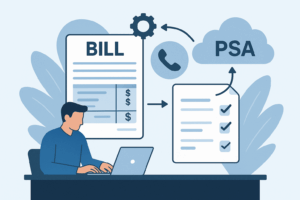
Those two realities create the LMS dilemma: an LMS can host content, but alone it cannot sequence prompts, push practice into the flow of work, or show whether use of a feature translates to better business metrics.
Our point of view
Our POV: training content is necessary but not sufficient. To turn learning into behavior you need three coordinated capabilities: targeted communications, in-the-flow delivery, and change analytics. Each on its own nudges behavior; together they create measurable adoption.
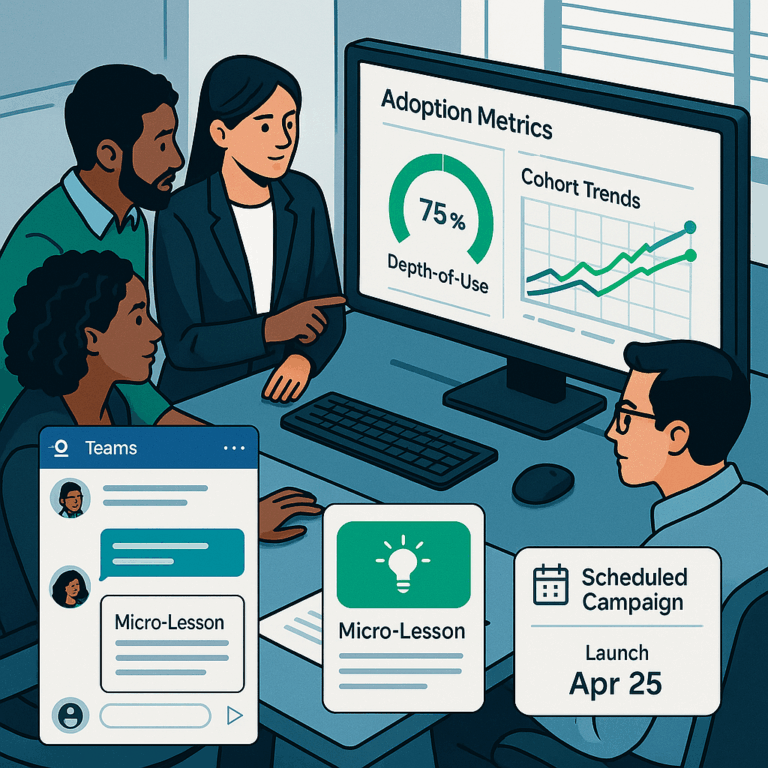
Targeted communications compress the time from awareness to action. For sales teams that means a message that arrives when an SDR is working opportunities, not an email buried in a weekly newsletter. In-the-flow delivery means micro-lessons and practice prompts appear inside the collaboration apps people already use, like Teams or Viva Learning, so the barrier to try is minimal. Microsoft’s Viva Learning shows how aggregation inside Teams increases discoverability and manager-driven assignment, which matters when you want practice to be part of daily routines. Overview of Microsoft Viva Learning.
Change analytics closes the loop. You must measure depth-of-use and cohort outcomes: who moved from watch-only to regular practice, which teams adopted a Copilot prompt set, and whether adoption correlated with KPI changes like reply rates or time-to-MQL. Our POV: dashboards should tie learning cohorts to feature adoption, not just completions.
A simple rubric: when an LMS is enough, when you need an adoption platform
Use this practical rubric to choose a path. Assumes a mid-market SaaS or tech buyer and a typical CRM + collaboration stack.
| Scenario | LMS alone | Adoption platform (comms + analytics) |
| Best for | Cataloging courses, compliance records. | Driving daily practice, segmented rollouts, measuring depth-of-use. |
| Comm capability | Limited—mail merges or portal announcements. | Targeted campaigns, scheduling, channel-specific nudges. |
| Analytics | Completion and quiz scores. | Feature usage, cohort paths, conversion to business KPIs. |
Score higher for an adoption platform when you care about pipeline velocity, license ROI, or time-to-proficiency. If you only need compliance records, an LMS is fine. If you want behavior change, choose the platform that ships comms and analytics together.
How to apply this to common personas
RevOps leaders: you want faster lead qualification and repeatable outreach quality. Run segmented campaigns that target new SDR hires with role-based micro-lessons, measure SDR activity on Copilot recipes, and correlate completion cohorts with time-to-MQL and reply rates. Track those conversions in one dashboard so you can show time-to-value to CFO and Sales leadership.
Demand Gen/Marketing Ops: personalization at scale fails when messages lack timing. Use targeted communications tied to behavioral triggers—for example, push a one-minute micro-lesson and a sample subject line to reps who opened a key playbook. Measure reply lift by cohort. This reduces generic outreach and improves conversion without extra headcount.
CRM admins and Solutions Architects: you care about hygiene and integration cost. Look for an adoption solution that integrates with HubSpot or Salesforce to enrich records automatically, sync completions, and surface which features are actually being used. That replaces manual tagging and saves admin hours.
Objections and common pitfalls
“We already have great content.” Great content helps, but it will not overcome habit, context, or time pressure. Without nudges and practice, even strong modules are forgotten. Implementation research shows that post-training environment determines whether skills transfer back to work. HBR.
“Analytics are vanity metrics.” Not if you measure the right things. Completions and logins are surface signals. Depth-of-use metrics—repeat feature calls, frequency of scenario use, or attestations completed—are the ones that map to business outcomes. Start with a small set of adoption KPIs and link them to the metrics your CFO or CRO cares about, such as pipeline velocity or revenue per rep.
“Change is too political.” You’ll get early wins by starting with pilot cohorts (sales managers, top-performers) and using outcome stories to build momentum. Short, targeted campaigns reduce change risk because they require less immediate process change than a full roll-out.
How BrainStorm solves the LMS dilemma
Outcome: measurable behavior change that increases depth-of-use and reduces license waste.
How: BrainStorm automates segmented communications, delivers role-based micro-lessons in Teams/Viva, and surfaces change analytics that link learning cohorts to feature adoption.
CTA: See your M365/Copilot adoption in a live dashboard—book a 20-minute demo.
Proof point: In a recent Copilot initiative, BrainStorm customers saw a 50% average increase in Copilot MAU and added 56,557 licenses across 73 accounts. Learn more about the Copilot pack.
Quick FAQ
Q: Isn’t an LMS cheaper?
A: Upfront yes. But if your goal is feature adoption and license ROI, the cost of unused licenses often outweighs the LMS savings. See the SaaS waste data from Zylo for context. Zylo 2024.
Q: What metrics should I track first?
A: Start with depth-of-use (active feature calls per user), cohort completion of scenario-based micro-lessons, and one business outcome (for example, reply rate or time-to-MQL).
Q: Can this work inside Teams?
A: Yes. Delivering learning inside Teams or Viva reduces friction and increases practice. Microsoft documents how Viva Learning brings learning into the flow of work. Microsoft Viva Learning overview.
Sources
Why Leadership Training Fails—and What to Do About It (Harvard Business Review)
2024 SaaS Management Index (Zylo)
Overview of Microsoft Viva Learning
Meta description: Why an LMS alone won’t change behavior: combine targeted comms, in-the-flow micro-lessons, and change analytics to drive measurable adoption. (156 characters)
Suggested URL slug: /blog/lms-dilemma-comms-analytics