
Last reviewed: December 8, 2025
Picture your next quarter’s SMB seat growth. If your direct team and legacy agent model carry the whole load, the math gets harder. The MSP community now sits between you and most business buyers, shaping what gets evaluated, bundled, billed, and renewed.
TL;DR: Growth in UCaaS, voice, connectivity, and cloud communications increasingly runs through MSPs. Analysts forecast that about 70% of technology, IT services, and telecom spend flows via partners, not direct. Canalys. Channel success hinges less on network quality and more on billing alignment with MSP workflows. Telecom wholesalers that remove billing friction, integrate with MSP PSA/accounting, and preserve partner margin will outgrow peers. The takeaway: treat MSPs as your downstream channel and make billing predictable.
Direct and legacy agent models dominated. That world is over.
For years, telecom providers relied on direct sales and traditional agents. That model still contributes, but it is no longer sufficient for SMB and mid-market expansion. Buyers want bundled outcomes delivered by a single accountable partner they already trust to manage endpoints, identity, security, and apps.
Multiple analysts point to the same direction of travel: partner-led routes to market now dominate technology and related telecom services. Canalys expects partner-delivered IT to account for roughly 70% of global customer spend in 2025, inclusive of technology, IT services, and telecom services. Canalys. UCaaS is one of the fastest-growing communications categories, reinforcing the shift to bundled, managed delivery. Grand View Research.
SMB and mid-market customers also report growing reliance on MSPs for lifecycle help. Analysys Mason has tracked the steady rise of SMB IT spending through MSPs and the openness to buy adjacent IT services alongside connectivity. Analysys Mason via PR Newswire. Strategy work in 2025 shows mid-market buyers favor local, relationship-driven ICT providers for integrated offers, another reason MSPs influence telecom decisions. BCG.
Our POV: MSPs are your downstream channel. Align everything to make them successful.
Statement: Treat MSPs as the primary route to market for SMB and mid-market communications. Operate like an enablement engine, not just a wholesaler. Make it easy for MSPs to sell, bill, collect, and support.
Mechanism: MSPs run monthly closes on PSA and accounting systems. If your catalog, rating, taxes, and invoice outputs don’t align, your partners carry financial risk and slow down. When billing is predictable and audit-ready, MSPs scale your seats. When it isn’t, they pause.
Trade-offs: A tighter MSP program means more structure on offers, discounts, and data. You trade some bespoke pricing for faster cycle time, lower disputes, and higher attach across voice, mobility, and connectivity. That trade usually improves gross-to-net realization.
Example: AT&T’s recent integrations show where the market is headed. The carrier leaned on PSA and billing partners to simplify how MSPs package and bill connectivity. Channel Futures. The lesson: remove friction where MSPs live, not in your portal.
A simple lens: billing alignment drives channel velocity
Use this framework to evaluate your MSP-readiness. Score each item Red/Yellow/Green and fix Reds first.
- Billing clarity and accuracy. Do rated usage, recurring charges, discounts, and adjustments consistently match quotes and agreements in the MSP’s PSA? One mislabeled line item creates a ticket and a delay.
- Workflow alignment with PSA/accounting. Can invoices and charge data flow into systems like ConnectWise, HaloPSA, Autotask, QuickBooks Online, or Xero without spreadsheets? Alignment cuts close time and write-offs.
- Margin preservation. Are partner buy rates and rebates transparent and stable through the term? Predictable unit economics increase MSP mindshare.
- Catalog and bundles. Are SKUs named the way MSPs sell (bundle-first, options second), with effective dates and proration rules that won’t surprise customer finance teams?
- Multi-tenant management. Can a partner manage many end-customers, sites, and numbers with consistent mappings, without re-keying data across portals?
- Operational scalability. Can you onramp 50 new MSPs in a quarter without custom projects by reusing the same catalog, rating, invoice templates, and data feeds?
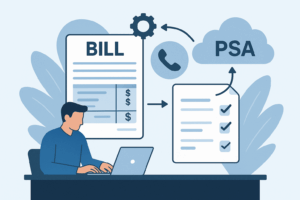
Diagram description: imagine a flow from Carrier Feeds (CDRs, recurring charges, surcharges) to a Billing Hub that normalizes, rates, and taxes, then to MSP Systems (PSA, accounting) and finally to End-Customer Invoices. The control points are catalog, mapping, taxes, and presentment.
What telecom wholesalers can do now
Start where the MSP lives. Document the top 10 invoice line items that cause disputes, and fix them at the source. Align your SKU names, effective dates, term logic, and proration rules with how MSP PSAs track agreements.
Offer a consistent, MSP-branded invoice option. Many mid-market finance teams reconcile by line item and date, not by network jargon. Clear labels reduce tickets and improve DSO. UCaaS growth means more seats, sites, and add-ons per account; clarity compounds value. Grand View Research.
Build an enablement kit the MSP can reuse. Include a standard catalog, price book, order form, tax-handling posture, invoice sample PDF, PSA mapping guide, and a billing calendar. Keep it the same for all partners to scale onboarding.
Pilot with 5 MSPs who already sell your services. Measure two things: days-to-first-invoice and disputes per 1,000 seats. Improve until both metrics are predictable.
How Datagate fits (billing hub for MSP-led telecom)
Outcome: Make it easier and safer for MSPs to sell and bill your services, so you win more seats through the channel.
How: Datagate acts as the billing hub that converts carrier feeds into MSP-ready invoices, integrates with PSA and accounting tools, and supports multi-jurisdiction telecom taxes through leading U.S. tax engines and international options. This reduces manual work, increases billing accuracy, and preserves partner margin.
See it: Read the SkySwitch story to see how MSP billing alignment accelerates channel growth. Datagate x SkySwitch case study. Or start a conversation: schedule a discussion.
Common objections and how to handle them
“We can’t risk channel conflict with our direct team.” Set clear segment rules and compensation guardrails. Many providers use account registration, named territories, and comp neutrality to avoid conflict. The cost of inaction is higher: MSPs route demand to offers they can bill cleanly.
“Telecom taxes are too complex to expose to partners.” Don’t shift tax calculation to MSPs. Centralize it in your billing hub and produce MSP-branded invoices with compliant tax detail. Your partners get audit-ready outputs without becoming tax experts.
“MSPs aren’t ready to sell connectivity.” Many are. And major carriers are actively making it easier by meeting MSPs inside their operational systems. Channel Futures. Give MSPs packaged offers, billable SKUs, and support commitments. Seats will follow.
“We can’t standardize our catalog.” You can standardize 80% and keep 20% flexible for strategic deals. Consistency beats perfect customization when you need scale.
FAQ
Is there a single number for “telecom sold via MSPs”? No single public metric exists. Directional data shows the majority of technology, IT services, and telecom spending flows through partners, while UCaaS grows quickly. Use this as a planning assumption and instrument your own channel metrics. Canalys, Grand View Research.
Where do we start inside the MSP workflow? Start with the monthly close: PSA agreements, ticket-to-bill rules, and accounting sync. If your outputs land cleanly there, adoption rises.
What should we measure? Days-to-first-invoice, disputes per 1,000 seats, DSO, partner gross margin, and attach rate across UCaaS, mobility, and connectivity.
Implications / Next steps
What to do: Declare MSPs as your primary route to market. Stand up a billing hub that integrates with PSA/accounting. Standardize a channel-ready catalog and invoice template. Pilot with 5 MSPs, then scale.
What to watch: UCaaS seat growth, attach to mobility and connectivity, dispute rates, and partner margin. Track how quickly new MSPs reach consistent invoicing.
Risks or tradeoffs: Catalog standardization requires change management. Tax compliance needs central ownership. Alignment with direct sales needs clear rules of engagement. The payoff is faster channel velocity and lower revenue leakage.
Sources
IT spending to expand 8% in 2025, partner-delivered IT to account for 70%
Unified Communication As A Service Market Report, 2030
Analysys Mason predicts SMBs will increase their spending on technology in 2023