
Last reviewed: December 8, 2025
Partners decide whether your telecom grows this year. MSPs sell telecom when billing is predictable, compatible, and under their control. Give them that model and your channel scales.
TL;DR: MSP-led distribution now drives most IT and telecom spend, so your billing must fit MSP workflows. The blocker is not network quality but billing friction inside PSA and accounting. Telecom wholesalers that standardize on an MSP‑compatible billing model unlock faster partner onboarding, fewer disputes, and higher attach on voice, data, and UCaaS. The takeaway: remove billing friction and your MSP channel performs.
Why MSP-led distribution is the route to growth now
Channel partners influence the majority of technology buying today. Canalys projects that about 70% of customer spending on technology, IT services, and telecom services will go through partners in 2025. That puts MSPs at the center of your go-to-market reality, not the edge of it. Canalys: IT spending to expand in 2025, partner-delivered IT ~70%.
At the same time, UCaaS keeps expanding as customers consolidate communications into subscription bundles. One forecast has global UCaaS reaching roughly $262 billion by 2030, with high-teens CAGR, driven by hybrid work and cloud migration. This demand flows through MSPs who own the customer relationship. Grand View Research: UCaaS market outlook.
Assumption: you operate a wholesale division serving MSPs directly or via distributors.
Our POV: billing, not network, decides MSP adoption
MSPs hesitate when invoices are unpredictable. A single mismatch between a quote and the first invoice can trigger credit holds, re-bills, and stalled projects. Every cycle spent reconciling spreadsheets increases partner cost to serve and reduces your product’s attach rate.
The economic truth is simple. If MSPs cannot control pricing, margins, and invoice outputs, they limit sales or seek alternatives. Network quality matters, but billing clarity determines partner trust at month-end close.
So the design goal is not just accurate rating. It is predictable billing that lands cleanly in PSA and accounting without manual rework. Do that and partners scale with confidence.
The MSP‑compatible billing model: five non‑negotiables
To fully adopt telecom, MSPs want five things. Treat these as design constraints, not options.
- Their own billing instance. MSPs need control over pricing, bundles, and margins. They must set catalog names, tiers, and terms, then roll them forward without asking your ops team.
- Fast onboarding. Weeks, not months. Avoid back‑and‑forth CSVs. Provide a guided setup for offer catalog, taxes selection, and PSA connection. Target a first invoice in one cycle.
- Automation. Ingest CDRs and usage, rate correctly, apply taxes via the chosen tax engine, and generate MSP‑branded invoices. No mid-cycle hand edits.
- PSA compatibility. Align with ConnectWise, Halo, Autotask/Datto, Kaseya, and Syncro. Map items once, then auto‑post each month with consistent item names and service dates.
- Accuracy. No surprises. No tax‑engine switches mid‑stream. Stable invoice templates, stable IDs, stable rounding rules.
Here’s a simple lens you can use to evaluate your model.
| Layer | What it does | Owner |
|---|---|---|
| Wholesale rating | Normalize carrier CDRs and usage | Telecom |
| Billing hub | Apply MSP pricing, bundles, taxes, invoice rules | MSP (per instance) |
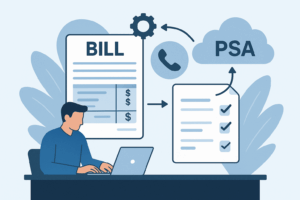
| PSA sync | Push items, agreements, and invoices | Billing hub |
| Accounting post | GL post, collections, revenue recognition | MSP system |
| Customer experience | Readable invoice, portal access, payment | MSP brand |
Concrete detail to validate: item names must match the PSA catalog exactly, including capitalization, or reconciliation slows.
How wholesalers implement this architecture without chaos
Start by productizing your wholesale offers as MSP‑ready bundles. Define a small baseline catalog with clear unit definitions, such as per seat per month and per minute. Freeze naming conventions early.
Introduce a multi‑tenant billing hub between your rating stack and partner PSAs. Give each MSP an instance where they control margin, taxes selection, invoice template, and dates. Your team still governs upstream rating and wholesale inputs.
Publish an onboarding path measured in milestones: connect usage sources, load catalog, map items to PSA, generate a dry‑run invoice, and confirm taxes presentation. Aim for first revenue inside 30 days from partner signature. Use a standard “Service Start Date” rule to avoid partials.
Operate to a monthly close checklist. Lock gate dates for usage cutoff, dispute window, and invoice release. Keep change control strict. For example, schedule any tax‑engine updates only at quarter boundaries with advance notice.
How Datagate helps
Outcome: faster MSP adoption and cleaner month‑end close. How: Datagate provides an MSP‑ready billing hub that converts CDRs and carrier usage into MSP‑branded, PSA‑compatible invoices while preserving your wholesale logic. See the approach in this case study. Ready to evaluate fit? Contact us.
What good looks like for product, channel, and architecture leaders
Product leaders define a stable catalog and guardrails. They set naming, rounding, and proration rules up front to avoid disputes. They publish a change calendar and treat billing outputs as product features.
Channel owners sell billing confidence. They show partners a sample invoice and the exact PSA sync flow. They commit to a 30‑day onboarding plan and escalate any disputes inside a 5‑day window.
OSS/BSS architects minimize integration debt. They keep wholesale rating decoupled from the MSP instance and use the billing hub to normalize outputs. They avoid PSA‑specific logic in core systems.
Example practice: include “Invoice Period Start” and “Invoice Period End” on every line. Customer finance teams reconcile faster and file fewer tickets.
Objections and pitfalls to address early
“Our portal already invoices.” Portals invoice, but MSPs need control inside their own instance. If they cannot edit bundles and margins without tickets, they won’t scale your line.
“The MSP can bill from their PSA.” PSAs are not rating engines. Without a billing hub that turns usage into PSA‑ready items, partners end up with spreadsheets and manual fixes. That increases their cost to serve and slows your bookings.
“Taxes change constantly. We can’t guarantee accuracy.” True, which is why you should freeze tax providers per partner instance and time‑box changes. Communicate any engine updates in advance and only on predetermined dates.
“We don’t want another system.” A billing hub reduces total complexity. It decouples wholesale rating from MSP invoicing and lowers ticket volume tied to mismatched outputs.
Final takeaway for telecom executives
To grow through MSPs, remove billing friction. Give partners their own billing instance, fast onboarding, automation, PSA compatibility, and accuracy. The rest follows.
FAQ
How is this different from giving MSPs a portal login? A portal is shared and upstream‑centric. An MSP instance is theirs, with pricing, bundles, taxes, and invoice templates under their control.
Can we roll this out while keeping our current rating stack? Yes. Insert the billing hub after rating and before partner PSAs. Keep upstream rating stable.
What metrics prove success? Time to first invoice under 30 days, dispute rate below 1% of invoices, and PSA auto‑post success above 99%.
Sources
Canalys: IT spending to expand in 2025, partner-delivered IT ~70%
Grand View Research: Unified Communications as a Service market outlook
Implications / Next steps
- Productize a small, stable wholesale catalog with strict naming rules.
- Stand up a multi‑tenant billing hub and assign every MSP their own instance.
- Standardize a 30‑day onboarding path with a dry‑run invoice checkpoint.
- Publish a quarterly change calendar for pricing, taxes, and invoice templates.
- Show partners a sample invoice and PSA sync flow during recruit and enable.