
Last reviewed: October 17, 2025
Every month your telecom bill hides a small army of line items: federal charges, state taxes, municipal surcharges, 911 fees, and a dozen regulatory pass-throughs. For MSPs that consolidate connectivity for customers, those line items are operational risk unless billing, rating, and tax mapping are nailed down.
TL;DR: MSP finance and ops leaders must treat telecom taxes as a multi-layered system: federal-level contribution programs, state and local taxes (sales, gross receipts, utility), and a host of mandated surcharges (911, state USFs, PUC fees). Map each charge to the right product code, automate rating and tax calculation in your billing flow, and export clean ledger entries into PSA and accounting. Datagate speeds this by centralizing usage rating, telecom tax logic, and PSA exports so invoices match regulatory requirements and reduce disputes. Book a 15-minute first-invoice review.
Why telecom taxes matter now for MSPs
Telecom taxes look small on a single invoice. Rolled together across customers and providers they change margins and create audit exposure. Many tax items are non-negotiable and change by jurisdiction. Worse, line-item names differ by carrier and state, so a one-size mapping in your PSA will under- or over-collect.
Imagine a mid-market SaaS customer with 120 seats across three states. One provider bills a “Regulatory Recovery Charge.” Another lists “State 911 Fee.” If you record both under a generic tax account in the PSA you lose visibility into which charges are refundable or reportable, and AR reconciliations spike.
What good looks like: a single rated record for each call, message, or session with a clear tax type code (for example: USF, State Sales, Municipal Utility Tax, 911 surcharge). That lets billing engines and accountants classify, file, and defend those amounts quickly.
Our point of view: treat telecom tax as a policy+tech problem
Policy alone won’t fix billing. Neither will a manual spreadsheet. Our POV: you need three things—accurate tax logic, automated rating that attaches tax codes at the usage level, and a deterministic export into PSA/accounting. Skip any of those and disputes, write-offs, and refund headaches follow.
Trade-offs are real. Building tax rules in-house requires ongoing research into state PUC filings and municipal ordinances. Outsourcing to a tax engine speeds coverage but adds cost and integration complexity. Our recommendation: centralize rating and tax decisions in a single middleware layer between carriers and your PSA. That preserves audit trails while keeping invoice templates flexible.
Assumes a mid-market MSP billing stack and at least one PSA (ConnectWise or Autotask) and an accounting system (QuickBooks or Xero).
A simple framework: federal, state, local, and surcharges
Use this lens when you review carrier invoices and your rate/charge maps.
| Layer | What it is | Common examples |
|---|---|---|
| Federal | Nationwide programs usually collected as a percent of interstate/total telecom revenue. Not a broad federal sales tax. | Universal Service Fund (USF) contribution, FCC-administered charges |
| State | State sales/use taxes, gross receipts taxes, state USFs and regulatory fees. Taxability varies by service type and state. | State sales tax on bundled services, state USF surcharge, PUC administrative fee |
| Local / Municipal | City or county levies that apply to telecom and utility services. Often fixed-fee per line or percent-based. | Municipal utility tax, local business tax, cable franchise fees |
| Surcharges & Fees | Statutory, often earmarked fees such as 911/E911, state 911 funds, and emergency communications charges. | 911/E911 fees, enhanced 911, state E911 fund assessments |
Factlet: the federal Universal Service Fund is administered through the Universal Service Administrative Company. For details see What is universal service?.
How to map charges (practical checklist)
- Capture carrier line-item code and description. Don’t rely on the invoice label alone.
- Classify by tax type code (USF, State Sales, 911, Municipal Utility).
- Attach jurisdiction granularity to usage (state, county, city).
- Apply the right tax engine or rule set during rating, not after invoice generation.
- Export tax breakdown to PSA and accounting as discrete ledger lines.
Applications and runbook for Revenue Ops and Billing teams
Revenue Ops needs predictable margins. Billing teams need fewer disputes. Here’s a practical walkthrough for a first invoice after adding a new carrier.
Step 1: Test ingest. Import a Carrier CDR or sample invoice into your rating engine. Validate the raw fields: call start, duration, ANI, Billed Party, and charge code.
Step 2: Run rating rules that output a usage record with tax code fields populated (for example, tax_code=USF; jurisdiction=CA; surcharge_type=E911). If your rating output lacks tax fields, add a mapping layer.
Step 3: Generate a draft invoice in a sandbox and compare totals to the carrier sample. Look for three common mismatches: rounding, jurisdiction mismatches, and bundled-product taxability rules.
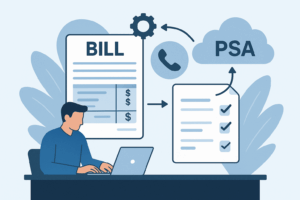
Step 4: Export to PSA with line-level tax codes and reconcile AR buckets. If a customer queries a 911 fee, you can show the taxed line and the statutory basis rather than a single undifferentiated tax total.
What good looks like in tooling: a rating layer that supports CDR import, attaches tax logic (AvaTax/CCH-style codes), and exports to ConnectWise or QuickBooks. See our integrations page for typical connectors: Integrations. For usage and rating specifics, review our feature page: Usage rating.
Outcome: invoices with accurate, auditable tax and surcharge lines so AR closes faster. How: we centralize usage rating, apply telecom tax rules, and export clean ledger lines into PSA and accounting. Book a 15-minute first-invoice review.
Common objections and pitfalls (and how to avoid them)
“We already collect a single ‘tax’ line — why complicate?” A single line prevents correct reporting, makes refunds harder, and hides regulatory exposure. Breakouts are operationally cheaper than audits.
“We can hand-update mappings as carriers change.” Expect carrier description changes and new surcharges after PUC filings. Manual updates scale poorly. Our POV: automate rule updates or subscribe to a telecom tax engine and centralize overrides in your middleware.
“Which charges are refundable?” That depends. Some state taxes are refundable; some surcharges are statutory and non-refundable. Always correlate the tax code to the statute or filing that authorizes it before returning cash to a customer.
This article is general information, not tax or legal advice. Confirm requirements with your advisors and applicable regulations.
FAQ
Q: Is there a federal telecom sales tax I must collect?
A: There is no broad federal sales tax on telecom services. However, federal-level programs like the Universal Service Fund are collected on telecom revenues. For program details, see the FCC Universal Service Fund overview.
Q: Who sets 911/E911 fees?
A: States and municipalities set 911/E911 fees and filing rules. The National Conference of State Legislatures maintains a summary of 911 fees and charges: 911 fees and charges.
Q: When should I use a tax engine vs. manual rules?
A: Use a tax engine if you bill across many states and jurisdictions or if you need delegated maintenance of taxability rules. If your footprint is small and stable, a vetted manual mapping may work short-term. Our POV: plan to move to an automated tax source as you scale.
Sources
- What is universal service? — Universal Service Administrative Company (USAC)
- Universal Service Fund (USF) — Federal Communications Commission
- 911 fees and charges — National Conference of State Legislatures
- Avalara Telecom tax resources — tax engine and taxability guidance (industry reference)
Success metrics: lower dispute rate on telecom invoices, faster AR by reducing manual corrections, and cleaner PSA entries so finance can reconcile by tax code. Want the 12-minute fit check? Book a 15-minute first-invoice review.
Legal disclaimer: This article provides general information, not tax or legal advice. Confirm requirements with your advisors and applicable regulations.