Last reviewed: December 8, 2025
Partners, not direct sales, decide whether your wholesale or white-label offer scales this year. If managed service providers can sell and bill you cleanly, they expand seats. If they can’t, they pause. No one wins a renewal with a messy invoice.
TL;DR. Growth in wholesale and white-label telecom now rides on MSP-led distribution. The barrier isn’t network performance; it’s billing friction that collides with MSP finance workflows. Telecom executives need to align offers, pricing, and invoice outputs with how MSPs operate across PSA and accounting. The takeaway: remove billing uncertainty and MSPs will sell more of your connectivity and voice.
The MSP law of motion for wholesale telecom
Wholesale and white-label models are simple: if MSPs succeed, you grow; if MSPs struggle, you stall. The channel now intermediates the majority of IT and related telecom spend. Canalys estimates that partner-delivered IT will account for about 70% of the total addressable market in 2025. Canalys: IT spending to expand 8% in 2025, partner-delivered IT to account for 70%.
Demand for cloud communications remains material, even as broader UC markets mature. Some forecasts show steady UC growth, while UCaaS-specific studies project faster expansion through 2030, especially in North America. See Gartner: Forecast Analysis: Unified Communications, Worldwide and Grand View Research: UCaaS Market.
Implication for telecom wholesalers: your downstream MSP channel is the route to market. Channel velocity lives or dies on how predictable billing is for the MSP and their customer.
Why billing decides channel velocity
Most white-label providers invest heavily in network and platforms. The stall happens later, when invoices don’t match MSP quotes, item names drift from the MSP catalog, or usage lands outside the MSP’s billing calendar. That triggers rework, disputes, and deferred seat adds.
MSPs need three things: invoice clarity, workflow fit, and margin protection. When those exist, account managers lead with your offer. When they don’t, they sell something simpler. Billing isn’t a back-office detail. It’s the channel’s lifeline.
The MSP operating model: a simple lens for telecom wholesalers
MSPs build their businesses around control: of process, of revenue, and of the customer experience. Your wholesale program should reinforce that control, not erode it.
| Friction | What MSP experiences | Impact on your channel | What you can change |
|---|---|---|---|
| Billing unpredictability | Invoices don’t match quotes or PSA agreements | Disputes, slower cash, stalled seat expansion | Consistent rating, naming, dates, and bundles |
| Process misalignment | Manual exports into PSA and accounting each month | High ops cost, avoid selling telecom to new logos | Automated feeds that match MSP close cycles |
| Catalog drift | SKU names and bundles differ per system | Confusion in renewals and MRR leakage | Governed catalog and mapped bundle templates |
Assumption: mid-market MSPs with standard PSA and cloud accounting stacks.
What telecom executives can change in 90 days
Start with outcomes, not tools. Define the billing experience you want an MSP to have, then work backward.
- Standardize bundle definitions. Publish price book, dates, and naming conventions that match typical PSA fields.
- Set one billing calendar. Align cutover, proration, and credit timing so invoices reconcile on first pass.
- Protect partner margin. Make discounting rules explicit and consistent across SKUs and add-ons.
- Enable multi-tenant views. MSPs need to manage many end customers in one pane, with separation and roll-ups.
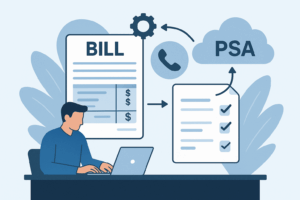
- Automate data flow. Replace spreadsheets with predictable exports into PSA and accounting each month-end.
Our POV. Direct sales won’t cover the SMB and midmarket efficiently. Your partner program must remove billing risk so an MSP can add a line, expand seats, and trust the invoice will land clean. That’s how channel revenue compounds.
Why a telecom billing hub enables MSP success
A dedicated billing hub converts carrier usage and CDRs into the packaged services MSPs actually sell. It aligns rating, taxes and surcharges handling, invoice presentment, and data syncs with MSP systems. The result is predictable outputs and lower operational risk for everyone.
Datagate operates as that hub for MSPs and their upstream providers. It produces MSP-branded invoices, aligns to PSA and accounting workflows, and keeps catalogs consistent so renewals are cleaner and faster. When billing is trusted, MSPs lead with your offer and expand seats naturally.
How Datagate helps. Outcome: clean, MSP-ready billing that accelerates partner-led sales. How: a billing hub that translates telecom detail into MSP-ready bundles and invoices, integrated to the systems MSPs already use. See the Datagate case study library.
Addressing common objections and pitfalls
“Our network is best-in-class; billing shouldn’t matter.” It does when the MSP’s AR team can’t reconcile charges. Network quality opens the door. Billing quality closes the sale and the renewal.
“We’ll build our own billing.” Feasible, but it diverts engineering from core network value and rarely keeps pace with MSP workflow changes. The tradeoff is time-to-channel versus control. A hub approach gives control at lower operational cost.
“MSPs can handle complexity.” They can handle known, documented complexity. Unpredictable complexity causes them to stop selling. Your goal is predictability.
How Datagate helps. Outcome: fewer disputes and faster month-end. How: standardized rating, governed catalogs, and automated outputs that match MSP close cycles. Talk to us about integration maps and deployment options on the Datagate contact page.
FAQ
Isn’t UC growth slowing? Some UC segments are maturing, but partner-delivered IT remains dominant and UCaaS continues to expand in key regions. See Canalys and Grand View Research.
What’s the first fix if disputes are common? Lock the catalog. Align SKU names, dates, and bundles so invoices match quotes. Then automate exports to the MSP’s systems.
Can we resell or white-label a billing hub? Yes. Resell to speed go-to-market. White-label if you want to own the experience and add professional services for deployment.
Bottom line for telecom executives
To grow through MSPs, telecom wholesalers must remove billing friction. Align your offers and invoice outputs with the MSP operating model, and use a billing hub to make that alignment durable. When MSPs trust the billing, they sell more of your services.
Sources
- Canalys: IT spending to expand 8% in 2025, partner-delivered IT to account for 70%
- Gartner: Forecast Analysis: Unified Communications, Worldwide (July 15, 2025)
- Grand View Research: Unified Communication as a Service Market (accessed Dec 2025)
Implications / Next steps
- Audit your partner invoices against quotes for three recent deals; count the adjustments.
- Freeze a governed price book with mapped bundles and names that align to MSP systems.
- Decide: resell a billing hub now for speed, or white-label and add professional services.
- Review integration maps and case studies, then schedule a deployment plan with Datagate.